
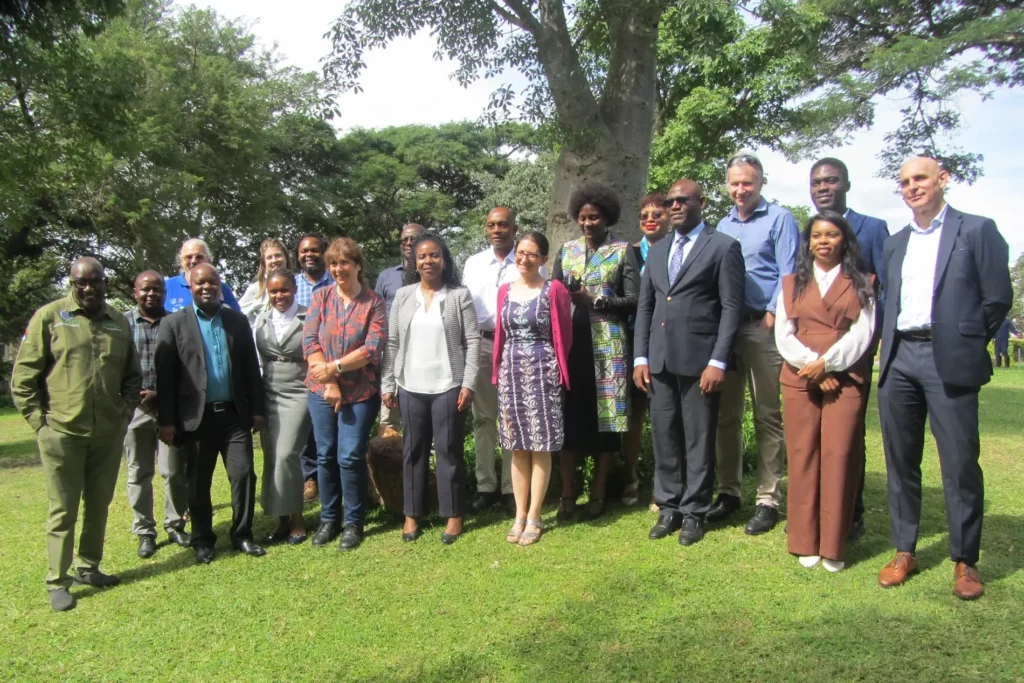
The Research for Agroecology Network Southern Africa (RAENS) held its annual reflection and planning meeting in Lusaka, Zambia from 3-6 February 2026. In his opening remarks, Dr Ndashe Kapulu, director of project partner and meeting host, Zambia Agriculture Research Institute (ZARI), reminded RAENS partners that “Agroecology is not just a vision but a living, breathing movement … it is not just a science but a promise for food security and resilience.” That remark captured the spirit of agroecology as science, movement and practice (Wezel et al, 2009) and set the tone for the meeting.
The goal of the project is to establish a robust, innovative, and sustainable multi-actor transdisciplinary agroecology research and knowledge network in Southern Africa to:
- Strengthen existing initiatives;
- Showcase the potential and scalability of agroecology;
- Facilitate shifts in agricultural training and research towards agroecological and regenerative ways of producing food, fibre and fodder; and
- Inform policy, thereby leading to an enabling landscape for agroecology uptake, research and training.
Over the course of the 4-day meeting, project partners1 reflected on progress made during the first year of implementation and laid out their plans for year two across the four main workstreams of RAENS:
1) Establishing a research network to improve coordination of agroecology research in the region, in collaboration with farmer organisations, extension workers, market actors, civil society groups and other grassroots practitioners.
2) Developing a learning network, to develop the next generation of agroecology scholars and practitioners in the region. This will include development of agroecological curricular materials for various levels of teaching, as well as supervision of students;
3) Knowledge management and dissemination, to increase the availability and awareness of agroecological knowledge materials, methodologies and tools; and
4) Evidence-based policy analysis and advice, to contribute to an improved policy environment for gender-sensitive agroecological transitions at local, national and regional levels.
RAENS partners from the five participating countries—Malawi, South Africa, Tanzania, Zambia and Zimbabwe—and beyond shared their progress with regard to establishing national-level agroecology networks, selecting pilot sites for farmer-led agroecology research, and developing communities of practice on key agroecology themes. They also highlighted progress on scoping studies related to agroecology curricula and policy.
An exciting development is the establishment of an agroecology knowledge hub, hosted by the Transformative Partnership Platform for Agroecology (AE TPP), which will become a one-stop shop for agroecology resources for Southern Africa. RAENS partners also took time to discuss strategic issues related to growing the RAENS network and defining their shared position on agroecology.
No meeting on agroecology should take place entirely in a meeting room—this one took a break to visit the Kasisi Agricultural Training Centre (KATC), an agroecology training centre and organic farm outside of Lusaka that is a regional leader in agroecology education. KATC is also a member of the Seed and Knowledge Initiative (SKI). The visit was a highlight of the meeting, and a chance for RAENS partners to engage with KATC personnel on agroecological practices, training methods, farmer-led research and marketing agroecological produce.
RAENS hosted its first public event as a network on 5 February 2026, on “Bringing together research, teaching and practice to advance agroecology”. Participants included RAENS partners, SKI partners as well as other agroecology stakeholders from academia, civil society, government and the private sector in Zambia. During their remarks and the discussion that followed, panellists Frank Tchuwa of Lilongwe University of Agriculture and Natural Resources (LUANAR), Charles Nkhoma of Community Technology Development Trust (CTDT), Sussana Phiri of Young Professionals for Agricultural Development (YPARD) and Father Claus Recktenwald of KATC shared their experiences with farmer-led research and breeding, agroecology curriculum development and training, and the participation of youth in agroecology.
By the end of the week, RAENS partners had more clarity on the way forward to expand the regional network, begin pilot site research and launch the regional communities of practice. They also strengthened their relationships within RAENS, and with others outside of the network. Partners left with a renewed commitment to ensuring that agroecology research, teaching and advocacy improve the lives of small-scale farmers and their communities.
By Brittany Kesselman

Brittany Kesselman is a researcher with the Bioeconomy Chair at the University of Cape Town in South Africa, where she coordinates the Research for Agroecology Network Southern Africa (RAENS). The project involves 8 implementing partners in 5 Southern African countries (Malawi, South Africa, Tanzania, Zambia and Zimbabwe) and Europe. It builds national- as well as regional-level agroecology knowledge networks and focuses on research, curriculum, knowledge dissemination and advocacy in support of agroecological transitions in the region. Her current research focuses on the intersections of agroecology and indigenous food and farming knowledge and practices. Previous work has focused on the impact of colonialism on indigenous foodways in South Africa, challenges of urban food injustice, migration and dietary change, community food institutions, urban agriculture and food sovereignty.