
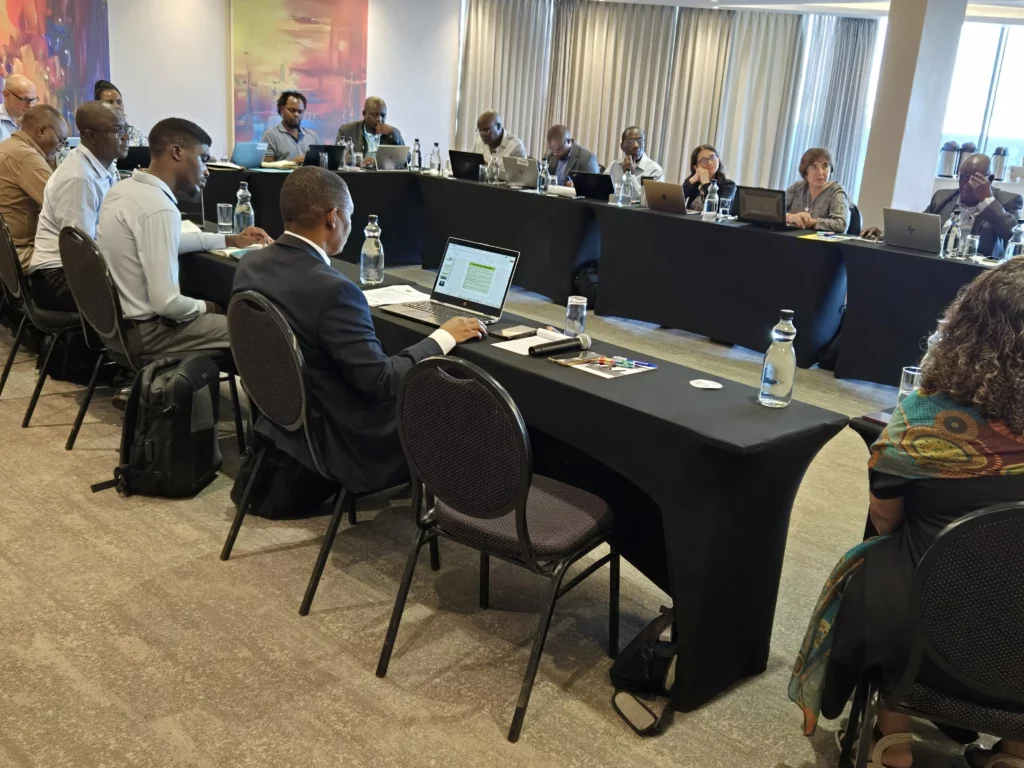
The RAENS inception meeting was held at the Lagoon Beach Hotel in Cape Town, South Africa, from 25-28 February 2025. Over the course of four days the members of the eight implementing partners (see box below) had time to get to know each other better and to meet officials from the coordinating partner, CCARDESA (Centre for Coordination of Agricultural Research and Development for Southern Africa). The meeting also granted the opportunity to spend time with a representative of the project funder from the European Union Delegation in Botswana, as well as representatives from the Forum for Agricultural Research in Africa (FARA), and the Regional Universities Forum for Capacity Building in Agriculture (RUFORUM). Aside from making these important connections happen, the meeting provided the space for everyone involved in RAENS to develop the project’s programme of work and craft modalities for working together.
THE RAENS IMPLEMENTING PARTNERS
- University of Cape Town (UCT), South Africa (project lead)
- Lilongwe University of Agriculture and Natural Resources (LUANAR), Malawi
- Sokoine University of Agriculture (SUA), Tanzania
- Marondera University of Agriculture, Science and Technology (MUAST), Zimbabwe
- The Zambia Agricultural Research Institute (ZARI), Zambia
- Center for International Forestry Research and World Agroforestry (CIFOR-ICRAF), Zambia office
- Research Institute of Organic Agriculture (FiBL), Switzerland
- Young Professionals for Agricultural Development (YPARD), Germany
The regional RAENS network is linked to similar networks in East Africa – Regional Multi-actor Research Network on Agroecology in East Africa (RMRN-EA) and West Africa – Agroecology Network to Promote the Sustainability of Food Systems in West and Central Africa (RADiUS, the French acronym). These three networks receive continental coordination and support from FARA and RUFORUM.
The overarching goal of RAENS is to:
Establish a robust, innovative, and sustainable multi-actor transdisciplinary agroecology research and knowledge network in Southern Africa to:
o Strengthen existing initiatives;
o Showcase the potential and scalability of agroecology;
o Facilitate shifts in agricultural training and research towards agroecological and regenerative ways of producing food, fibre and fodder; and
o Inform policy, thereby leading to an enabling landscape for agroecology uptake, research and training.
RAENS has four components, namely:
1) Establishing a research network to improve coordination of agroecology research in the region, in collaboration with farmer organisations, extension workers, market actors, civil society groups and other grassroots practitioners.
2) Developing a learning network, to develop the next generation of agroecology scholars and practitioners in the region. This will include development of agroecological curricular materials for various levels of teaching, as well as supervision of students;
3) Knowledge management and dissemination, to increase the availability and awareness of agroecological knowledge materials, methodologies and tools; and
4) Evidence-based policy analysis and advice, to contribute to an improved policy environment for gender-sensitive agroecological transitions at local, national and regional levels.
The group agreed on the following ground rules to guide their continued engagement:
Openness
Good participation
Listening
“De-roling” (taking off the hats that are not relevant)
Outside-the-box thinking
Respecting each other’s views
Being present
Observing time management
Through a series of plenary presentations followed by discussions, the participants came to grips with technical issues such as reporting, procurement, governance and implementation arrangements, external communications guidelines, and the draft contract.
An external expert provided a session on gender and agroecology, and the participants worked together in small groups to brainstorm and deepen thinking around the four project components. The following topics were discussed: pilot sites for agroecology research and innovation, communities of practice, students and supervision, knowledge management, and policy and advocacy. In terms of pilot sites, members of the research network will undertake farmer-led agroecological research at pilot sites in the five member countries – South Africa, Zimbabwe, Zambia, Malawi and Tanzania. Additionally, regional communities of practice will be established on key agroecology topics.
A session on monitoring and evaluation was followed by input from FARA and RUFORUM regarding their support for Regional Centres of Excellence on Agroecology (the other name for the 3 RMRNs). The European Commission’s Joint Research Centre weighed in on their scientific support to the RMRN Project. On the last day of the meeting, the group of project implementers and project coordinators sat in on the first, virtual meeting of the project’s Advisory Board. Participants learned that the Advisory Board would meet annually and although Board members would receive project reports for their information and interest, they do not have an executive or fiduciary function. The meeting was fast-paced, and a lot of ground was covered, but there was time for relaxation too as the bright lights of the Victoria & Alfred Waterfront beckoned across the bay. A number of the participants caught a shuttle to the Waterfront to go shopping and browse through the food stalls at the Oranjezicht City Farm Market.
Overall, the meeting was productive and stimulating, made for stronger connections across the region and institutions, and laid the foundations for a thriving collaboration.
Photo: Bridget Kakuwa